

simforge rig validate and was rendered with the runtime on easterbrook-discovery-school, exactly as shown, on an RTX 5080. Copy one into a file, change what you need, and check it with simforge rig show. All three use the vehicle frame of a car: x forward, y up, z left, in metres from the centre of the car’s box at ground level.
Front camera
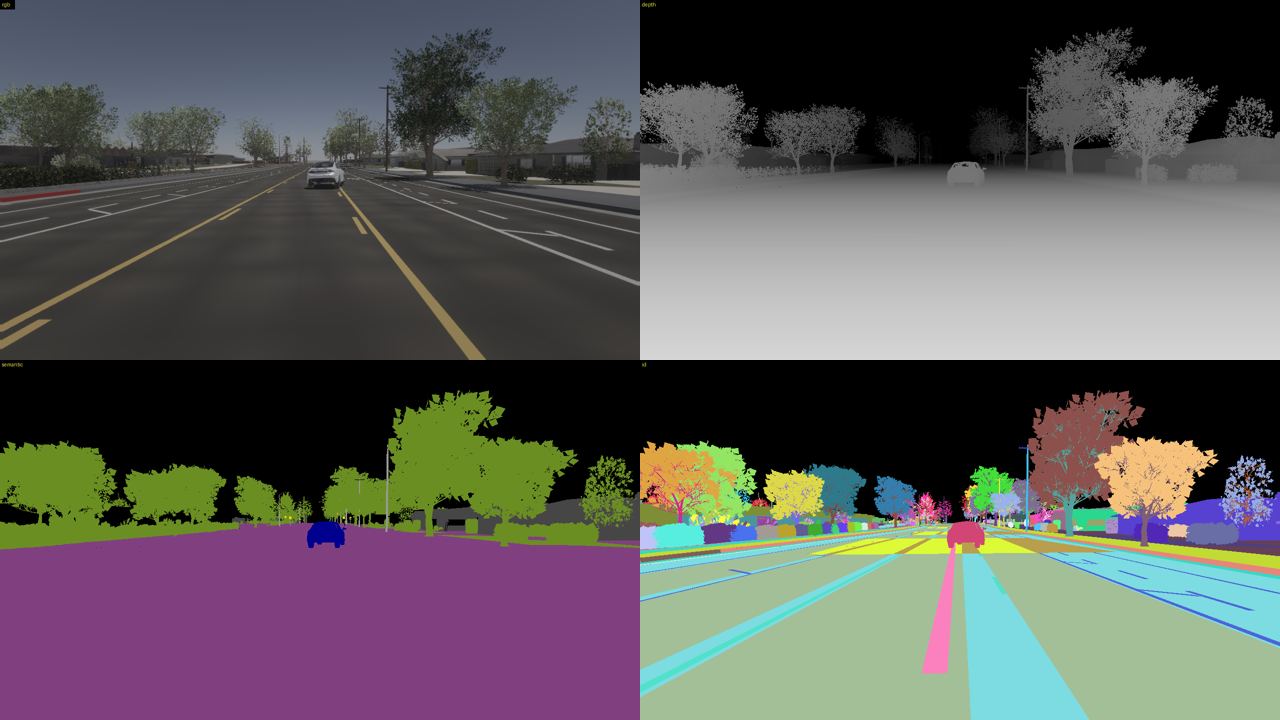
One forward camera on the windscreen, 1280x720 at 20 fps with a 90 degree field of view, tilted 3 degrees down (pitchRad -0.0524).
--passes: the image (into the camera’s video; --video off writes PNGs instead), metric depth, semantic classes and instance ids (here colourised for display; the files hold the raw values, see sensor outputs).
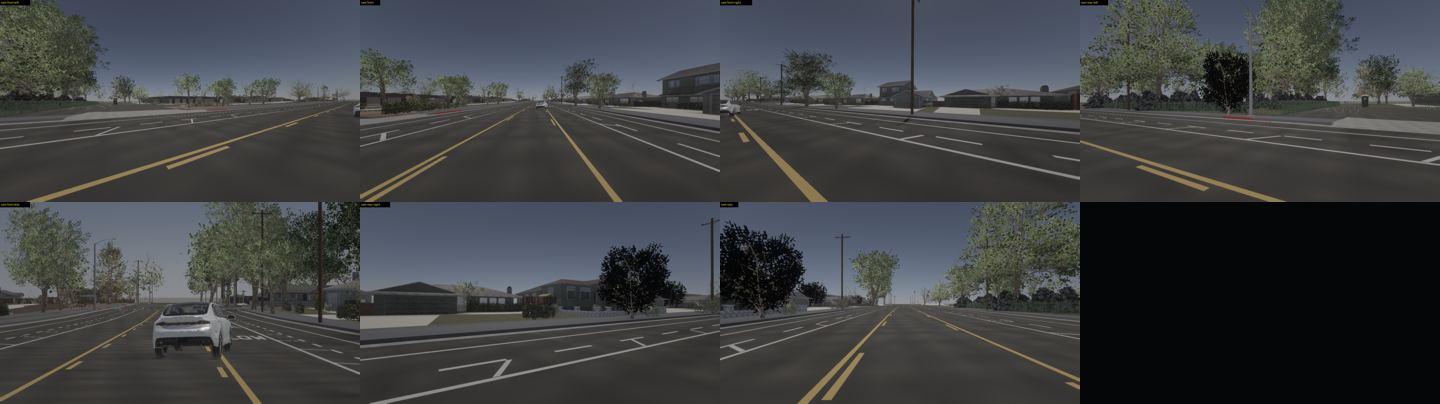
Seven-camera surround rig
A layout like the camera arrays of common driving datasets: a wide and a telephoto camera looking forward, two front-corner cameras at 60 degrees, two rear-corner cameras at 120 degrees, and one camera looking back. Together they cover the whole horizon;simforge rig show reports "coveredDeg": 360.0 and no gaps.
The rear camera’s yaw is 3.14159, inside the allowed range of -pi to pi; 3.1416 is just outside it and fails validation.
Camera, lidar and radar
The front camera, a 64-channel roof lidar and a forward radar 0.2 m ahead of the front of the box. The lidar spins at 10 Hz with a symmetric vertical field of +15 to -15 degrees and 1.2 million points per second, so each scan has up to 64 x 1875 points. The radar casts 1500 rays per second over a 90 x 10 degree field. A rig with a radar needsvideo: its fps (20 here) is the radar’s sample rate.
.ply point cloud for the lidar and one .csv of detections for the radar at every frame, and a review video for each sensor.
